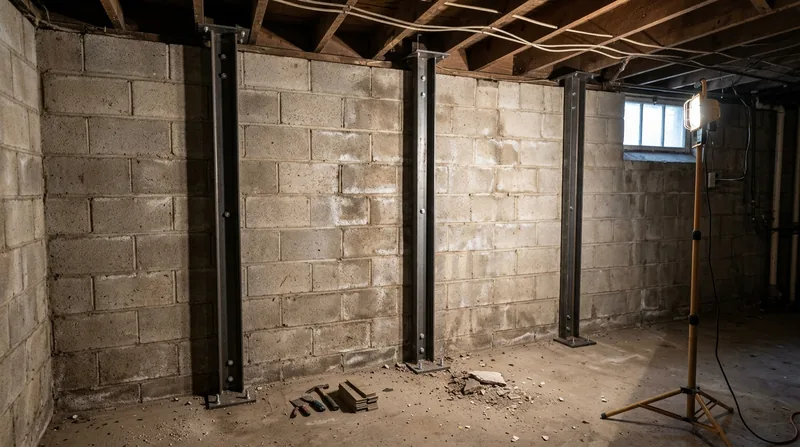




A Bowing Wall Repair in Youngstown is structural work, not a cosmetic patch. The Mahoning Valley sits on dense glacial till clay that drains slowly, and that clay pushes hard against block and brick foundations once it saturates. In the older neighborhoods around Wick Park and along the North Side, 1900s to 1930s foursquares sit on full basements with original block walls that have been taking that pressure for a century. Brier Hill and the South Side add steel-era frame homes on shallow footings, while Boardman, Austintown, and Struthers carry 1940s to 1960s brick ranches on block basements. We read the wall, check the soil, and match the repair to the movement. Call (234) 230-7202 for a free inspection, or start with our free basement inspection.
Why Bowing Walls Are Common in Youngstown's Glacial Clay
Youngstown's freeze-thaw cycle is the engine behind most bowing walls. Water soaks into the clay in late fall, freezes, expands, and shoves against the foundation. Spring snowmelt adds hydrostatic pressure from the outside, and the wall cracks or bows inward. Sandstone ledges along Mill Creek gorge and river-bottom ground near the old mill sites make drainage unpredictable, so the same storm hits two houses differently.
- Horizontal cracks in the middle third of a block wall signal pressure, not settling.
- Walls that lean inward more than 1 inch over 8 feet need a structural repair plan.
- Efflorescence and white powder mean water is moving through the block right now.
- Sticking doors and uneven floors often accompany a wall that is already moving.
If any of those signs are present, the wall has to be stabilized before any crack sealing will hold.
Key info: A 1910s foursquare near Mill Creek Park with a block wall bowing 2 inches is a carbon fiber strap job. A 1950s brick ranch in Boardman with a wall pushed in 4 inches may need steel I-beams. The method follows the movement, not the age of the house.
For official guidance on structural permits in the city, check the City of Youngstown building department before work begins. Rules vary by jurisdiction and must be verified.
How We Repair a Bowing Wall in Youngstown
We start below grade, at the footing. The repair has to resist the same clay pressure that caused the movement, so we measure the bow, map the crack pattern, and check the drain tile and grading around the foundation. If water is still loading the wall from outside, stabilizing the wall without addressing the water is a short-term fix.
- We excavate a small inspection pit at the footing to confirm wall thickness and soil condition.
- We measure the inward deflection with a plumb line and record it for the repair plan.
- We install carbon fiber straps, steel I-beams, or wall anchors based on the severity of the bow.
- We address the water source with exterior waterproofing or an interior perimeter drain as needed.
- We seal remaining cracks with epoxy or polyurethane injection and verify the repair.
Every repair ends with a written record of the deflection so the next inspector can see what changed.
Key info: On a 1920s home in Struthers, a block wall had bowed 1.5 inches after decades of clay pressure. Carbon fiber straps on the interior face stabilized it in one day, and a exterior waterproofing scope handled the water that was still pushing on the wall.
Repair Methods We Use and When Each One Fits
The right method depends on how far the wall has moved and what the soil is doing. Carbon fiber is the least invasive option for moderate bowing. Steel I-beams carry more load for severe movement. Wall anchors reach out to stable soil and pull the wall back over time. Epoxy injection is for cracks only, never for a wall that is actively bowing.
| Approach | Description | Best for |
|---|---|---|
| Carbon fiber straps | Straps bonded to the interior wall face and anchored top and bottom. | Moderate bowing under 2 inches, block walls. |
| Steel I-beams | Vertical steel beams set against the wall and tied into the floor and joists. | Severe bowing or walls that are cracked through. |
| Wall anchors | Earth anchors outside the wall connected to interior plates. | Walls that can be pulled back gradually. |
| Epoxy injection | Structural epoxy pumped into cracks under pressure. | Non-moving cracks in poured concrete. |
| Polyurethane injection | Flexible foam that seals active leaks in cracks. | Wet, seeping cracks that need to stay flexible. |
We combine methods when the wall shows both movement and active leakage.
Bowing Wall Repair Cost in Youngstown: What to Expect
Pricing for bowing wall repair starts at $600 for a small crack injection or a single strap repair on a minor bow. Most full stabilizations run higher because the work involves structural materials, excavation, and sometimes drainage corrections. The number moves with wall length, deflection, access, and whether water is still loading the wall. Get two or three estimates and compare scopes, not just totals.
For a detailed breakdown of line items, see our pricing page. A 1950s ranch in Austintown with a long block wall and poor grading will price differently from a short wall in a Canfield two-story on poured concrete.
Choosing a Bowing Wall Repair Contractor Near Me in Youngstown
Ask three questions before you sign anything: are you licensed and insured, what method are you using and why, and will you pull the permit. Structural foundation repair commonly requires a permit in Ohio, and the local building department sets the threshold. Get references from jobs in Youngstown, Boardman, or Poland and call them. A contractor who cannot explain the difference between a strap and an anchor is not the right fit.
We are a Basement Health Association member and carry a transferable warranty on structural repairs. Reach out through our contact page to schedule a free inspection at (234) 230-7202.
Wall Anchors vs Carbon Fiber: Which One Does Your Wall Need
Carbon fiber straps hold a wall where it is. Wall anchors pull it back. If the bow is under 2 inches and the soil outside is stable, straps are usually enough. If the wall has moved further or the clay is still pushing, anchors or steel I-beams are the safer choice. We check the footing and the drain tile before recommending either, because a wall that keeps taking water will keep moving.
If you are also seeing seepage, pair the structural repair with foundation crack repair so the wall and the water are handled together.
When a Bowing Wall Is an Emergency in Youngstown
A wall that has moved more than an inch in a single season, or one with a horizontal crack wider than a quarter inch, needs a look now. In Youngstown the risk window is late winter and early spring, when snowmelt saturates the clay and the frost leaves the ground. If you see a wall bulging after a heavy rain, do not wait for the next season.
We respond to emergency calls in Youngstown and the surrounding Mahoning Valley. Call (234) 230-7202 and we will schedule an inspection within 24 hours.
Bowing Wall Repair in Youngstown: Pricing Guide
| Service | Price | Details |
|---|---|---|
| Crack injection (epoxy or polyurethane) | Starting at $600 | Seals a single non-moving or seeping crack; price rises with crack length and access behind finished walls |
| Carbon fiber strap repair | Starting at $1,200 | Interior straps on a moderately bowed block wall; price moves with wall length and number of straps |
| Steel I-beam stabilization | On estimate | Severe bowing needs an on-site look at footing, soil, and deflection before a number is given |
| Wall anchor system | On estimate | Requires exterior excavation and stable soil reach; scope depends on yard access and anchor depth |
| Travel | Included | in Youngstown and surrounding areas, no separate call-out or mileage fee |
| Estimate | Free | Response within 24h at (234) 230-7202, no obligation to book |
Indicative pricing, the exact cost depends on square footage, finish, and site access. Free personalized estimate within 24h at (234) 230-7202.


