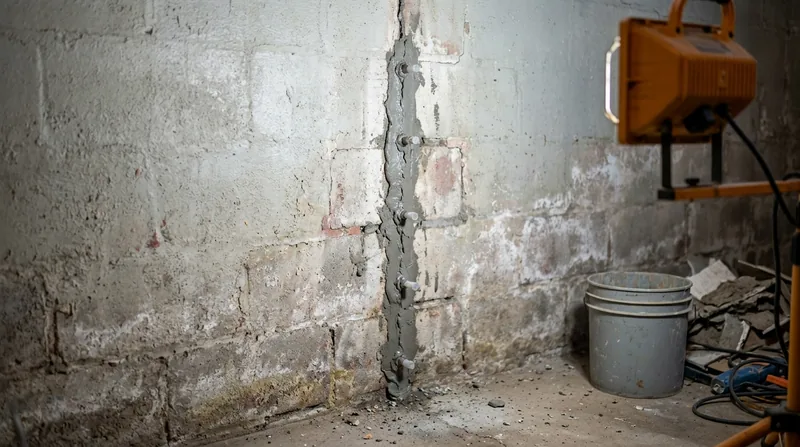




Foundation Crack Repair in Youngstown
If you have a crack running down a sandstone or brick foundation wall in one of Youngstown's 1920s Tudors near Mill Creek Park, or a hairline seam opening in a poured-concrete basement out in Canfield, you are looking at the same problem from two different angles: water finding a path. Foundation Crack Repair in Youngstown is what we do every week in this valley, and we do it by matching the repair to the crack instead of patching everything the same way.
The Mahoning Valley sits on dense glacial till clay that drains slowly, and that clay pushes hard against basement walls every time the water table climbs after a heavy spring snowmelt or a summer thunderstorm. Add hard freeze-thaw cycles, sandstone ledges along the Mill Creek gorge, and river-bottom ground near the old steel-mill sites, and you get a city where wall seepage is a fact of life, not a rare event.
We are a dedicated basement waterproofing specialist, not a general foundation-repair firm and not a plumber. That means when we look at a crack, we tell you plainly whether simple injection is enough or whether hydrostatic pressure is the real driver and an interior drain tile system is the better answer than exterior excavation.
Why Foundation Cracks Open Up in Youngstown and the Mahoning Valley
Youngstown's building stock is old and varied, and each era fails in its own way. The 1890s to 1920s Tudor and Colonial Revival homes around Wick Park sit on sandstone and brick foundations that were laid by hand and have been taking freeze-thaw punishment for a century. The 1900s to 1930s steel-era frame homes and foursquares across the North Side, the South Side, and Brier Hill have full basements with block or brick walls that move with the clay. Out in Boardman, Austintown, and Struthers, the 1940s to 1960s Capes and brick ranches on block basements show horizontal and stair-step cracking where the footing settles. Canfield, Poland, and Howland have 1980s to 2020s poured-concrete basements that crack at the shrinkage seams and at the corners.
What ties all of them together is the soil and the weather:
- Glacial clay soil holds water and swells, then pushes against the wall as hydrostatic pressure builds after a storm.
- Freeze-thaw cycles open hairline cracks wider each winter, especially on north-facing walls that stay frozen longer.
- Mature oaks, maples, and hemlocks pull moisture from the soil and shift it seasonally, which is why cracks near big trees tend to move.
- Downspouts that dump next to the foundation and grading that slopes back toward the house send roof water straight into the crack.
That is why we inspect every crack before we quote a repair, and why we tell some homeowners that sealing alone will not hold if the water is coming up from below.
Key info: A brick foundation on a 1915 foursquare on the North Side behaves very differently from a 1990s poured wall in Poland. Brick absorbs and spalls; poured concrete cracks at seams and corners. We size the repair to the wall, not to a catalog page.
For the official word on permits and inspections for structural foundation work in the city, check the City of Youngstown building department before any structural repair begins.
How We Diagnose and Repair a Foundation Crack in Youngstown
Every crack gets the same first step: we look at it, we look at the wall around it, and we look at the water. We check for efflorescence (the white salt bloom that tells us water has been moving through the wall), we check whether the crack is vertical, stair-step, or horizontal, and we check whether the wall is bowing. That diagnosis decides the method.
- We walk the basement and mark every crack, noting width, direction, and whether it is wet or dry.
- We check the exterior grade, downspout extensions, and window wells to see where the water is entering the soil.
- We test for hydrostatic pressure by looking at the base of the wall, the floor seam, and the sump basin.
- We choose epoxy injection for stable structural cracks and polyurethane injection for active leaks and moving cracks.
- We drill injection ports along the crack, flush the crack clean, and inject under pressure until the material fills the full depth.
- We finish the surface, verify the seal, and tell you what grading or drainage work will keep the crack from reopening.
If the inspection shows the wall is moving, we stop talking about injection and talk about carbon fiber straps or wall anchors through our bowing wall repair work.
Key info: A homeowner in Struthers had a vertical crack in a 1950s block wall that leaked every spring. Polyurethane injection stopped the leak in one visit, but the real fix was extending two downspouts and regrading the side yard. Injection alone would have failed by the next snowmelt.
Injection Methods We Use and When Each One Fits
The table below shows how we match the method to the crack. We do not sell one method for every wall.
| Approach | Description | Best for |
|---|---|---|
| Epoxy injection | Structural epoxy fills the crack and bonds the concrete back together. | Stable vertical cracks in poured walls, Canfield and Poland basements. |
| Polyurethane injection | Flexible foam expands with water and seals active leaks. | Wet, moving cracks in block and brick, North Side and Brier Hill. |
| Surface seal and parging | Hydraulic cement and parging close the face of the wall. | Cosmetic cracks and spalled brick on 1920s Tudor foundations. |
| Carbon fiber straps | Straps anchor the wall and resist inward movement. | Cracks that come with a bowing wall in Austintown and Boardman. |
| Drainage correction | Downspout extensions, grading, and footing drain work move water away. | Cracks that keep leaking because the soil stays saturated. |
Most single cracks in a poured wall are a one-visit injection job. Cracks that come with a wet floor, a running sump pump, or a wall that is moving need the bigger conversation.
Foundation Crack Repair Cost in Youngstown: What to Expect
Most homeowners want a number before they call, so here is the honest version. Single-crack injection in the Youngstown area typically starts around $450, and that covers the inspection, the ports, the material, and the finish on a standard vertical crack. The price climbs with the number of cracks, the length and depth of the crack, the wall material (brick and block take longer than poured concrete), and whether we find a bowing wall or a drainage problem behind the leak.
What moves the number most is not the crack itself but what is causing it. A crack that leaks because a downspout dumps at the corner is a cheap fix. A crack that leaks because the water table is pushing against the whole wall is a different job, and we will tell you that on the estimate instead of selling you an injection that fails in a year. That is also why we recommend two or three estimates on anything beyond a single crack: you want to compare diagnoses, not just prices.
You can see the full breakdown on our pricing page, and we will always put the scope in writing before work starts.
Choosing a Foundation Crack Repair Contractor Near Me in Youngstown
Hiring for crack repair is mostly about asking the right questions. A contractor who cannot explain why your crack is leaking is a contractor who will patch it and leave. Here is what to check before you sign anything.
- Ask for proof of licensing and insurance, and ask for the certificate to be sent to you directly.
- Get two or three written estimates with the scope spelled out, not a verbal number.
- Ask for references from jobs in your part of the valley, because a North Side brick foundation and a Canfield poured wall are not the same repair.
- Ask whether the work needs a permit (structural foundation repair often does, and rules vary by jurisdiction), and confirm who pulls it.
- Ask what happens if the crack leaks again, and get the warranty terms in writing.
We are a Basement Health Association (BHA) member and we carry a transferable warranty on our injection work. If you want to talk through your crack before you commit to anything, contact us and we will set up a free inspection.
Key info: A homeowner in Boardman had three quotes for the same crack. Two were injection-only. The third found a failing footing drain and a saturated side yard. The right answer was injection plus drainage, and the two cheap quotes would have leaked again by spring.
If you are in the 44503, 44512, or 44515 zips, you can also check our Youngstown service page for local details.
Foundation Crack Repair in Youngstown: Pricing Guide
| Service | Price | Details |
|---|---|---|
| Single crack injection | Starting at $450 | Includes inspection, injection ports, epoxy or polyurethane material, and surface finish on one standard vertical crack |
| Multiple crack injection | Starting at $750 | Covers two to four cracks in the same basement, with price driven by crack length and wall material |
| Structural crack repair | On estimate | For cracks with a bowing wall, carbon fiber straps or anchors are quoted after an on-site structural assessment |
| Crack repair with drainage correction | On estimate | Injection plus downspout, grading, or footing drain work when hydrostatic pressure is the real cause |
| Travel | Included | In Youngstown and surrounding Mahoning Valley communities, with no separate call-out or mileage fee |
| Estimate | Free | Response within 24 hours at (234) 230-7202, with no obligation to book the work |
Indicative pricing, the exact cost depends on square footage, finish, and site access. Free personalized estimate within 24h at (234) 230-7202.


