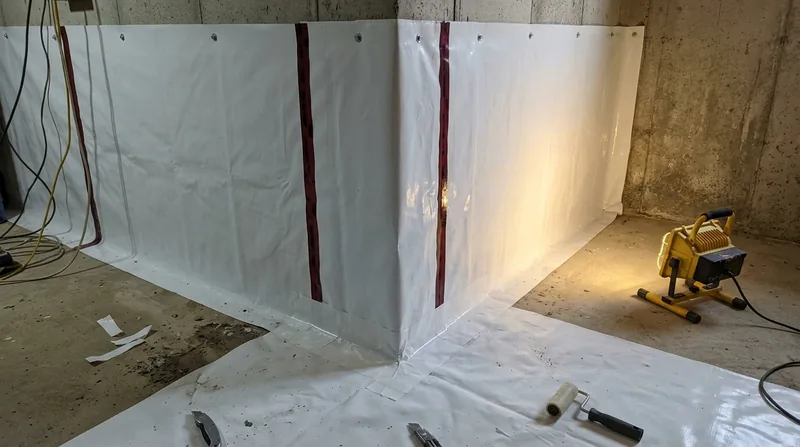




If you own a home in Youngstown, you already know what the Mahoning Valley does to a basement. The dense glacial till clay under the North Side and Brier Hill drains slowly, and the sandstone ledges along the Mill Creek gorge push groundwater sideways instead of down. Add lake-effect snow, a hard spring snowmelt, and summer thunderstorms that dump an inch in an hour, and the moisture has nowhere to go but through your foundation walls and slab. That is where Vapor Barrier Installation in Youngstown earns its keep: heavy-duty barrier sheets on the walls and floor that stop ground moisture vapor from rising into your lower level. We are a dedicated below-grade specialist, not a general foundation firm and not a plumber, and we tell you plainly when a barrier is the right fix and when the real problem is hydrostatic pressure that needs drainage first. If you want the full picture of how sealing fits with drainage, start with our basement waterproofing service.
Why Vapor Barrier Installation Matters in Youngstown's Clay and Sandstone Ground
Most of the wet basements we open up in Youngstown are not flooding. They are sweating. A 1920s foursquare on the North Side or a Tudor near Wick Park sits on a sandstone and brick foundation that has been wicking ground moisture for a century, and the clay till around it holds water against the wall like a wet sponge. You get efflorescence on the block, a musty basement smell, and damp drywall at the bottom plate. A heavy-duty vapor barrier on the wall and slab cuts that vapor drive at the source.
- The barrier stops moisture vapor rising from damp glacial clay soil into the basement air.
- Sealed seams and taped terminations keep the sheet airtight at the rim and the floor joint.
- We integrate the barrier with the sump basin and discharge so water that does collect gets out.
- We keep the barrier clear of any future wall inspection points so you can still see the foundation.
On block basements in Boardman and Austintown, that combination of a sealed barrier and a working sump is usually what turns a damp, smelly lower level into usable space.
Key info: In the older frame homes and foursquares across the South Side and Brier Hill, the slab is often thin and unsealed. We see vapor rising through the floor as much as through the wall, so we barrier both surfaces and tape the wall-to-floor transition rather than treating the wall alone.
Permits for work that alters drainage or the sanitary connection of a sump discharge vary by jurisdiction, so always confirm requirements with the City of Youngstown building department before work starts. You can check the city's official pages at youngstownohio.gov.
How We Install a Vapor Barrier in a Youngstown Basement
We start by finding out where the moisture is actually coming from. A free basement inspection tells us whether the wall is wicking, the slab is sweating, or the drain tile is already backed up. If hydrostatic pressure is the driver, a barrier alone will trap water behind it, so we recommend an interior perimeter drain first and barrier second. When the barrier is the right call, here is the sequence we run.
- We clear the perimeter, inspect the wall for cracks, and note any bowing wall or active seepage.
- We seal active cracks with epoxy or polyurethane injection before any sheet goes up.
- We fasten heavy-duty barrier sheets to the wall with a mechanical termination at the top.
- We overlap and seal every seam and tape the terminations at the rim and floor joint.
- We tie the barrier into the sump basin where one exists, or recommend a sump installation if it does not.
- We leave the discharge line and check valve accessible and walk you through the finished system.
If your basement already has a drain system, we coordinate with our interior drain tile system so the barrier and the drain work as one assembly instead of fighting each other.
Key info: A 1950s brick ranch in Boardman had efflorescence up the block and a musty smell every spring. The slab was unsealed and the wall was wicking. We injected two hairline cracks, installed wall and slab barrier, and tied it to the existing sump. The efflorescence stopped recurring after the next snowmelt.
Vapor Barrier Options We Use in Youngstown Homes
Not every basement needs the same sheet. The right choice depends on whether you are dealing with wall vapor, slab vapor, or both, and on how the foundation was built. Here is how the main approaches compare for Youngstown and Mahoning Valley homes.
| Approach | Description | Best for |
|---|---|---|
| Wall vapor barrier | Heavy-duty sheet fastened to the wall with sealed seams and taped top termination. | Brick and block foundations that wick and show efflorescence. |
| Slab vapor barrier | Sheet laid over the floor with taped overlaps and a sealed wall-to-floor joint. | Thin, unsealed slabs in older frame homes and foursquares. |
| Wall and slab combined | Continuous barrier from rim to floor, integrated with the sump basin. | Damp basements with both wall seepage and slab sweating. |
| Barrier with dimple board | Dimple board holds the sheet off the wall and gives water a path to the drain. | Bowing wall or active seepage where drainage runs behind the barrier. |
| Barrier after crack injection | Epoxy or polyurethane injection first, then barrier over the repaired wall. | Hairline and settling cracks that leak before the sheet goes up. |
We match the sheet and the termination method to the foundation we actually find, not to a one-size kit.
Vapor Barrier Installation Cost in Youngstown: What to Expect
Pricing for vapor barrier work starts from $3 per square foot, and that figure covers the sheet, fasteners, seam sealing, and taped terminations on a straightforward wall or slab. What moves the number is the condition of the foundation: crack injection before the sheet goes up, dimple board on a bowing wall, or a sump tie-in all add scope. Access matters too. A finished basement with paneling and carpet takes longer to clear than a bare block wall.
Two homes on the same street in Struthers can price differently because one has a dry, sound wall and the other has active seepage that needs injection first. That is why we inspect before we quote and why we tell you when a cheaper crack seal is enough. For a broader look at how barrier work fits with drainage and repair, see our full pricing overview. Getting two or three estimates is smart, and any contractor who quotes a barrier without looking at the wall is guessing.
Choosing a Waterproofing Contractor Near Me in Youngstown
When you search for vapor barrier installation near me, you get a mix of dedicated below-grade specialists, general foundation firms, and handymen. The difference shows up in what they inspect and what they put in writing. Ask three questions before you sign anything.
- Confirm the contractor is licensed and insured, and ask for a certificate of insurance before work begins.
- Get two or three written estimates that list the sheet type, seam method, and sump tie-in separately.
- Ask for local references from jobs in Youngstown, Boardman, or Canfield and call them.
- Ask who pulls any permit required for drainage or sump discharge work and confirm it with the building department.
We are a Basement Health Association member, and we will tell you when a barrier is not the answer. If you want a straight read on your basement, contact us for a free estimate at (234) 230-7202.
Vapor Barrier Installation in Youngstown: Pricing Guide
| Service | Price | Details |
|---|---|---|
| Wall vapor barrier | Starting at $3/sq ft | Includes heavy-duty sheet, fasteners, sealed seams, and taped top termination on a sound wall. |
| Slab vapor barrier | Starting at $3/sq ft | Covers floor sheet, taped overlaps, and sealed wall-to-floor joint on an unsealed slab. |
| Combined wall and slab | Starting at $4/sq ft | Continuous barrier from rim to floor, integrated with the sump basin where one exists. |
| Barrier with crack injection | On estimate | Epoxy or polyurethane injection of active cracks before the sheet goes up, priced per crack. |
| Travel | Included | in Youngstown and surrounding areas, no separate call-out or mileage fee |
| Estimate | Free | Response within 24h at (234) 230-7202, no obligation to book |
Indicative pricing, the exact cost depends on square footage, finish, and site access. Free personalized estimate within 24h at (234) 230-7202.


